Remember when “working in digital media” just meant managing a brand’s Facebook page or knowing how to slice together a basic promotional video? Those days are decisively in the rearview mirror. Today, the international media ecosystem is a complicated, lightning-fast puzzle driven by analytical algorithms, hyper-fragmented audiences, real-time data attribution, and complex mechanization.
For forthcoming students along with mid-career professionals, this change brings an exhilarating mix of huge breaks as well as indisputable pressure. How do you remain future-ready in a field that seems to rewrite its own rulebook every single season? The answer does not lie in chasing every single short-lived platform drift or learning a brief piece of software. In its place, it needs cultivating a deep, organizational understanding of digital media management.
Behind every smooth digital presence sits a person, frequently a small team, who planned it, measured it, and adjusted it long before you noticed anything at all. That work finally has a name people take seriously: digital media management. Depending on the number you trust, it’s silently becoming one of the more dependable, fastest-growing career paths on the planet.
This isn’t an intuition dressed up as a trend piece. It’s backed by figures large enough to make economists sit up and pay attention.
The Great Paradigm Swing: From Creation to Ecosystem Management
Let’s be completely candid: content creation itself is no longer the main bottleneck in the communication business. Generative tools as well as accessible design software have democratized production to a confounding degree. Almost anyone can record a high-definition video or assemble a clean layout in a matter of minutes. The real challenge and where the highest professional value now sits is in managing the disorder that follows.
Contemporary media management is not about hitting a “publish” button. It is about understanding the broader architecture:
- Knowing why a piece of content exists within a global framework.
- Determining how it shifts across diverse digital channels seamlessly.
- Evaluating its systemic impact through the lens of data analytics.
To flourish in this environment, professionals must develop a balanced-brain method. One half must be rooted in creative storytelling, human empathy, and cultural shades, while the other half must remain decisively planted in business approach, audience psychology, and performance metrics.
A Trillion-Dollar Feed
Worldwide advertising spend is expected to cross $1 trillion for the first time in 2026, with digital channels accounting for roughly two-thirds of that total. That’s not steady growth, it’s a basic shift in where attention and money essentially live now. A family-run bakery in Lisbon and a multinational bank in Singapore are, in a strange way, competing for the same scrollable real estate.
Layer on top of that the creator economy, appreciated at somewhere around a quarter-trillion dollars globally and still expanding faster than most traditional industries, and you get a picture of a field that isn’t plateauing anytime soon. The people who can manage that presence with any real skill aren’t a nice-to-have anymore. They’re the ones keeping the lights on.
A good digital approach today considers culture, language, timing, platform behaviour, visual identity, accessibility, and trust. It also recognises that what works in one area may not work in another. A campaign for Gen Z audiences in Southeast Asia may require a very different tone from a campaign targeting working professionals in Europe or educators in the Middle East. This worldwide complexity makes digital media management a stern professional discipline. It is no longer enough to know how to post. Specialists must know why something should be posted, who it is for, how it should be measured, and what impact it is expected to create.
These figures send a clear message to the corporate world: industries across the world do not just need more entry-level creators executing basic responsibilities. They are badly searching for digital architects, leaders who can audit a brand’s presence, securely integrate emerging technologies into a corporate workflow, and guide cross-functional teams toward quantifiable business objectives.
The Jobs Are Real, and They’re Multiplying
It’s fair to be cynical of breathless “future of work” headlines, so it helps to stick to figures that hold up under inspection. The U.S. Bureau of Labor Statistics projects digital marketing and media roles to grow by roughly 6 percent through 2032, comfortably ahead of the average for all occupations.
Zoom out to a worldwide lens and the picture gets even more interesting: The World Economic Forum’s Future of Jobs Report 2025, drawing on responses from over a thousand employers across 55 economies, projects a net gain of 78 million jobs worldwide by 2030, with the expansion of digital access named as the single most transformative force employers expect to reshape their businesses over that period.
And this development isn’t limited to wealthier economies, which matters if we’re being honest about what “global” should mean. In India, digital marketing roles extended by roughly 30 percent over just the past two years, with similar annual growth forecast through the rest of the decade. Parts of Southeast Asia and Africa are showing similar momentum as smartphone access widens and local businesses shift their budgets online for the first time. Future readiness, in other words, isn’t a Silicon Valley talking point. It’s a sincere worldwide recalibration of where work is heading.
The Three Pillars of Future Readiness
| Skill Pillar | Core Definition | Why Global Employers Demand It? |
| Data Fluency | Moving far beyond “vanity metrics” (likes and views) to master advanced data attribution, customer lifetime value modeling, and ROI analysis. | Organizations need to know precisely which digital touchpoints are driving authentic community engagement and corporate conversion. |
| Ethical AI Orchestration | Utilizing automated and generative systems to accelerate production speeds while strictly protecting brand integrity, intellectual property, and compliance. | The initial novelty of AI has faded; businesses now require managers who can audit automated outputs for quality, cultural sensitivity, and bias. |
| Omnichannel Architecture | Designing a cohesive, unified brand narrative that translates flawlessly across social search, long-form video, web ecosystems, and immersive spaces. | Modern audiences are hyper-mobile. A disjointed, fragmented digital presence across different platforms erodes brand trust almost instantly. |
Consider the increasing phenomenon of “Social Search.” A huge portion of younger demographics no longer utilizes old-style search engines to discover brands, news, or products; in its place, they turn directly to social video platforms. A future-ready manager distinguishes this shift and totally flips their search engine optimization (SEO) strategy, blending technical data architecture with creative, short-form storytelling.
AI Is Rephrasing the Job, Not Deleting It
The WEF report estimates that 39% of workers’ core skills will change by 2030, a figure that lands chiefly hard in digital roles where generative AI is already being used for content drafting, data analysis, and customer communication. That’s less a story of robots taking jobs and more a story of the job itself silently becoming a different job.
There’s a valuable business feature suppressed in all this too: Deloitte’s 2025 Global Human Capital Trends survey found that two-thirds of managers and executives feel new hires aren’t fully prepared for what’s really expected of them, with related experience quoted as the most common gap. Digital roles feel this intensely, because the tools and platforms they rely on change faster than almost any other corner of the business. It’s also part of why so many organizations now find it roughly 30% cheaper to reskill people already on staff than to hire fresh for the same capability. Staying up-to-date has become less of a virtue and more of a basic job requirement.
The most successful digital media managers do not view technical revolutions as a threat; they view them as a thoughtful liberation. By allowing automation to handle monotonous, time-consuming administrative tasks, such as baseline content formatting or programmatic ad placements, they clear away cognitive mess. This brand-new breathing room allows them to double down on what humans do best: building authentic communities, fostering deep brand loyalty, and crafting visionary communication plans.
Digital Media Is More Than Social Media
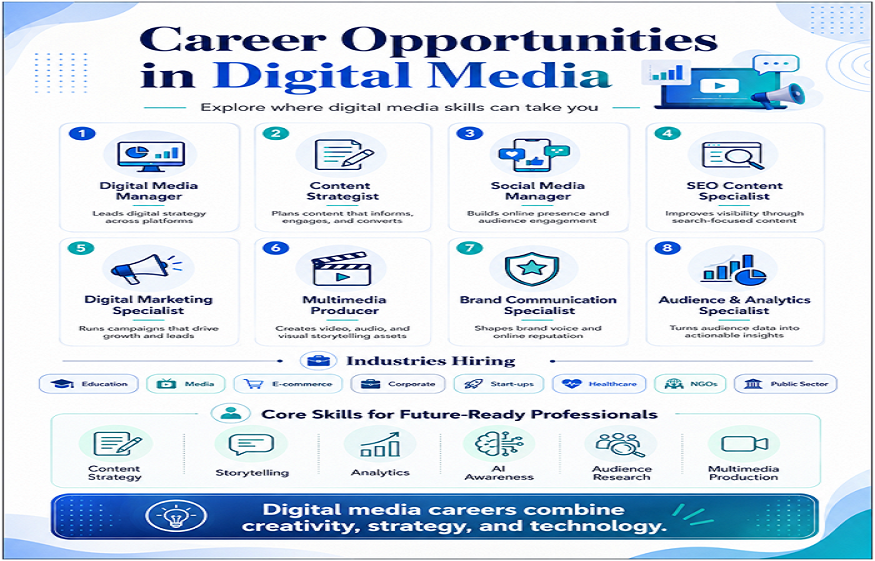
One common mistake is to reduce digital media to social media alone. Social media is important, but it is only one part of a much bigger ecosystem. Digital media management comprises content strategy, online branding, digital journalism, audience research, multimedia production, paid media, influencer collaboration, search visibility, email communication, analytics, campaign planning, online reputation management, and platform governance. In numerous organisations, it also connects with sales, customer service, public relations, education, and corporate communication.
A well-designed Master of Media Science in Digital Media can support this by helping learners connect theory with practice. Instead of only learning isolated tools, students explore how communication, technology, audience psychology, and media systems work together.
Career Opportunities Are Becoming More Diverse
The digital media job market is not limited to one type of role. Depending on interest and experience, professionals can discover careers as digital media managers, content planners, social media leads, brand communication specialists, media planners, digital campaign managers, online reputation executives, multimedia producers, digital journalists, SEO content professionals, and audience engagement specialists.
In the United States, the Bureau of Labor Statistics projects around 104,800 openings each year in media and communication professions from 2024 to 2034. While complete employment growth in this group may be slower than average, the continued number of openings shows the ongoing need for skilled professionals who can communicate efficiently across platforms.
Internationally, the picture is even wider. Digital advertising expenditure continues to rise, online video consumption remains strong, ecommerce is increasing, and organisations are investing more in digital-first communication. This produces demand for professionals who can manage media not just as content, but as a planned business function.
For professionals already working in marketing, journalism, teaching, training, public relations, design, or business development, digital media knowledge can add a strong layer of career mobility. It can help them move into roles that require both communication skill and digital confidence.
Why Higher Study Can Make a Difference?
Numerous people learn digital tools through short courses, online tutorials, or workplace experience. These are appreciated, particularly for specific platform skills. However, higher study offers something diverse. It helps learners understand the larger media environment.
A Master of Media Science in Digital Media can introduce learners to digital communication theories, media research, audience behaviour, content ecosystems, ethics, analytics, and emerging technologies. This wider foundation is especially useful for those who want to move into leadership, strategy, consulting, teaching, research, or international media roles.
A strong Media Master’s Program also encourages critical thinking. It helps learners ask better questions.
- Why does one message build trust while another creates resistance?
- How does platform design affect audience behaviour?
- What makes digital communication inclusive?
- How can data improve a campaign without reducing people to numbers?
These questions matter as future-ready professionals need more than operational aptitude. They need perspective.
Preparing for a Digital-First Future
The future of digital media will not belong only to people who know the newest app. It will belong to those who can understand change and respond with simplicity. Platforms will change. Algorithms will shift. Audiences will move. New tools will appear. But the need for meaningful communication will remain.
For potential students, this is a field with room to grow, experiment, and build a global career path with Master of Media Science in Digital Media. For working professionals, it offers a chance to upgrade existing skills and stay relevant in a changing economy.
Digital media management is no longer just about being online. It is about being strategic, responsible, creative, and ready for what comes next.In a world where attention is short and trust is hard-earned, future-ready digital media professionals will play a vital role. They will help organisations communicate better, connect with people more honestly, and create digital experiences that are not only visible, but appreciated.
FAQs
1. Why is digital media management important for future careers?
Digital media management is important because organisations now rely heavily on online platforms to connect with audiences, build trust, and grow globally. Professionals with digital media skills can work across marketing, communication, education, media, business, and brand strategy roles.
2. Who should consider a Master of Media Science in Digital Media?
A Master of Media Science in Digital Media is apt for graduates, working professionals, marketers, educators, content creators, journalists, entrepreneurs, and communication specialists who want to build advanced skills in digital strategy, media planning, content development, and audience engagement.
3. What skills are required for a career in digital media management?
Key skills include content strategy, audience research, data analysis, multimedia storytelling, social media management, SEO basics, digital advertising knowledge, AI awareness, communication skills, creativity, and ethical decision-making.
4. Why is future readiness important in digital media?
Future readiness is significant because digital tools, platforms, audience behaviour, and technologies change quickly. Professionals who can adapt, think strategically, use data wisely, and communicate responsibly are more likely to remain relevant in the evolving digital economy.
5. Is digital media only about social media?
No. Social media is only one part of digital media. Digital media also includes websites, blogs, search visibility, email marketing, video platforms, podcasts, paid campaigns, online communities, digital PR, analytics, and brand reputation management.